What is the best type of bag to store onions in? The answer depends largely on the situation. Onions that have just been harvested may require different packaging from those being stored for several months or transported to a busy local market. Although onions have firm outer skins, they still need proper airflow and handling to remain fresh.
Choosing the wrong bag can trap moisture, reduce ventilation, and increase the risk of mold, sprouting, or decay. In the following guide, we will compare the most suitable bags for onion storage and explain how to select the right option based on storage time, transportation conditions, and intended use.
First things first: onions shouldn’t go straight from soil to sack. Once pulled, they need to cure in a dry, shaded, and well-ventilated space—a barn rafter, mesh-bottomed drying rack, or wooden pallet with good air clearance. The goal here is to dry the necks and outer skins until they’re papery, rustly, and fully sealed. Bag too soon, and you’re locking in moisture. That’s how rot throws its little party.
Sweet onions, such as Vidalia or Walla Walla, tend to have a higher moisture content and shorter shelf life. They don’t always require full curing and should be bagged for transport or sale sooner than storage varieties.
After your onions pass the test, it’s time for bagging. For this stage, reach for mesh onion storage bags in the 25- to 50-pound range. These allow ample airflow and help shake off any lingering field dirt. Plus, they’re built for stacking without smothering the bulbs beneath.
A quick handling tip: if you're working alone or loading and unloading by hand, smaller 25-pound bags are easier to manage and less likely to get dropped or torn. And if you're stacking them for storage, use slotted pallets or ventilated crates—never flat on concrete. Airflow underneath is just as important as airflow through the bag.
If your onions are headed into deep storage—say, two to three months—you’ll want to think beyond “does this hold onions?” and focus on does this protect onions. For this, heavy-gauge raschel mesh bags are a smart choice. Raschel mesh features a coarse, knit-like weave that securely holds the contents while still allowing generous airflow. It’s strong enough to resist tearing, even with sharp necks or heavier loads.
Storage conditions matter here, too. Whole, raw onions perform best between 32 degrees Fahrenheit and 45 degrees Fahrenheit with relative humidity between 65 percent and 70 percent. Too warm, and they sprout. Too cold, and they soften. The right mesh bag won’t regulate temperature for you, but it will prevent trapped moisture and allow for proper air movement within shelving units or storage bins.
If you’re hanging bags (a great choice, by the way), give each bag space to “breathe.” At a minimum, leave three inches of clearance between bags to ensure airflow isn’t blocked. However, if you’re shelving instead, wire shelving or wooden slats with at least ½-inch spacing between slats are ideal. And mark your calendar: every 14 days, do a full inventory check. One rotten onion can spoil an entire bag if it goes unnoticed.
Moving onions is a test of patience and packaging. Bruised onions are a quick ticket to complaints at the stand. Whether your trip is 15 minutes or 150 miles, transport is a critical link in the onion-handling chain.
Tight-weave mesh bags with secure closures—think drawstrings or reinforced stitching—are your best friends here. They’re strong enough to withstand jostling but ventilated enough to prevent the onions from overheating in a warm truck bed or van.
Avoid piling them in deep stacks; keep stacks under 36 inches high to reduce pressure on the bottom bags. For longer trips, a thin sheet of burlap between layers helps distribute weight without cutting off airflow.
Green onions (also called scallions) follow a different path. Since they’re harvested young and sold fresh, they skip the mesh entirely and are usually packed into vented plastic crates or waxed produce boxes to help retain moisture.
And a quick note on what not to do: skip the sealed plastic or paper sacks. Even for short trips, those types of sacks trap heat and humidity, which can turn firm bulbs into steamed disasters. If you need temporary protection from rain or cold, use breathable liners and remove them as soon as you’re under cover.
Once your onions have made it to the farmers' market or onto a farm stand, they’ve entered their final form: attention-grabbers. In this setting, presentation matters just as much as preservation, and the bags you use need to work a little harder.
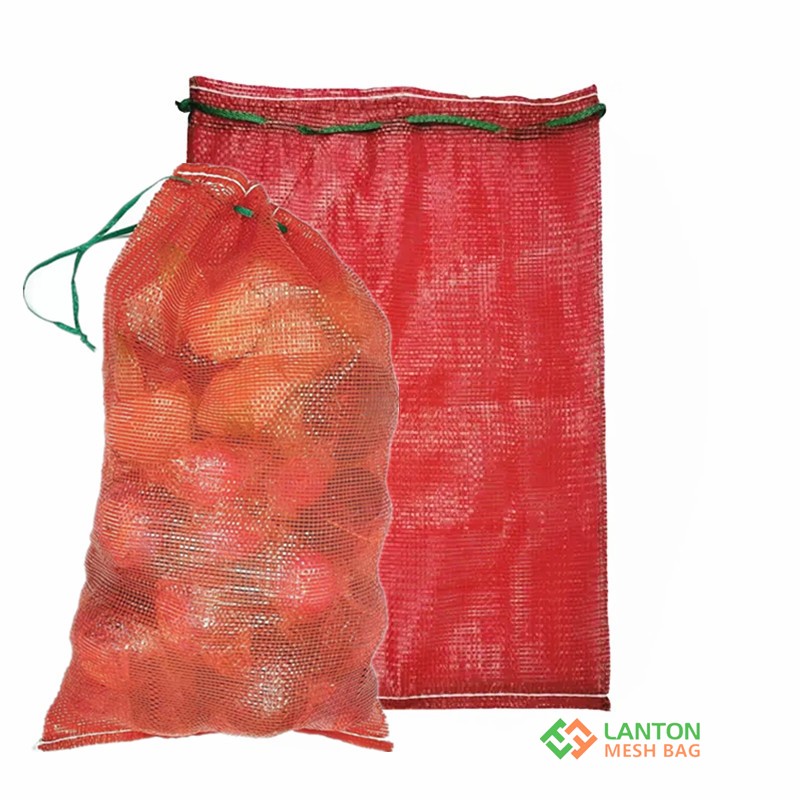
Colored mesh bags add visual flair and make the produce stand out against wooden tables or tent backdrops. A bright red mesh bag makes red onions appear deeper, white onions appear cleaner, and yellow onions appear more golden. All while still allowing air to flow in from every angle.
If you’re letting customers pick their own or offering grab-and-go bundles, mesh bags with soft handles are a smart choice. They’re lightweight, they drain easily if there’s morning dew, and they let the product shine while keeping it protected. Plus, there’s something oddly satisfying about the sound of a mesh bag being plunked into a tote.
Packaging onions for home delivery or CSA (Community Supported Agriculture) distribution presents a unique challenge: the packaging must be sturdy enough to withstand the rigors of transport while also being breathable, compact, and easy to store during transit.
For these smaller-scale needs, fine-mesh bags with a capacity of 2 to 5 pounds are the ideal choice. Their compact size allows them to fit easily into CSA delivery boxes or coolers without being crushed by heavier items—such as potatoes—stacked on top. Unlike paper or plastic bags, they do not trap excess moisture during "last-mile" delivery.
Furthermore, using smaller mesh bags naturally reduces the risk of onion damage (such as abrasions or bruising) by minimizing contact between the onions during transport. The tight mesh weave also effectively prevents onion skin flakes or field dust from spilling into delivery crates or the customer's kitchen.
Here’s one last tip before you commit to your next case of onion bags: store unused mesh bags flat and dry, in a cool, dark place, and out of direct sunlight. Moisture or UV exposure can weaken the fibers over time, leaving you with brittle or faded bags just when harvest hits. It’s smart to reorder once per harvest cycle, so your supply stays fresh and functional.
So, what is the best type of bag to store onions in? The answer depends on the timing and task, but in every scenario, breathable mesh is the go-to choice. From post-harvest cure to market table shine, a well-chosen bag keeps your onions fresher, longer, and far less likely to turn to mush before they sell.
If you’re looking for mesh onion bags wholesale, we’ve got you covered. At LANTON PACK, we stock breathable, durable onion sacks in a wide range of sizes—ideal for farmers, market managers, and anyone tired of watching their onions spoil before their time.
Order your onion bags in bulk from us today and ensure your next crop is handled correctly from start to finish.
Why Tubular Mesh Bags Are Suitable for Onion and
Drawstring vs Sewn Tubular Mesh Bags: Which Clos
5 Different Ways To Reuse Your Onion Mesh Bags
Contact: kevin Chau/ sherry Lee
Phone: +86-17731708815
Tel: +86-13831776642
Email: info@lantonltd.com
Add: west industrial area , Cangzhou City, Hebei Province, China


